
30 Day Money Back Guarantee
Rated 4.9 on Google Reviews
Call Now +1 (866) 589-9392
Delivery Across North America 🚚
30 Day Money Back Guarantee
Rated 4.9 on Google Reviews
Call Now +1 (866) 589-9392
Delivery Across North America 🚚
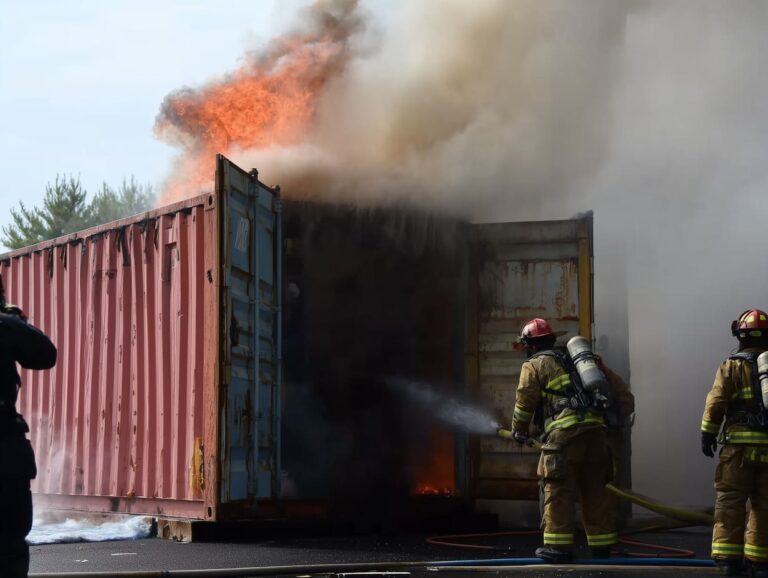
Shipping containers are often associated with storage, logistics, and industrial use, but their strength and durability make them valuable in far more demanding environments. This use case highlights how a California fire department incorporated used Corten steel shipping containers into a live training facility to help prepare firefighters for real emergency scenarios.
Rather than serving as static storage units, these containers became hands-on training structures designed to withstand extreme heat, heavy water use, and repeated physical stress. The result is a scalable and cost effective training solution that closely mirrors real world conditions firefighters face in the field.
Firefighting is a profession where preparation directly impacts outcomes. When seconds matter and conditions are unpredictable, hands-on training is essential. Classroom instruction alone cannot replicate the heat, smoke, water, and physical resistance encountered during an actual emergency.
Training facilities must be able to support activities such as:
Traditional training structures are expensive to build and difficult to modify once completed. For departments looking to expand training capabilities, flexibility and durability are critical.
Corten steel is known for its strength and resistance to extreme conditions. It is the same material commonly used in outdoor fire pits and architectural features because it can withstand prolonged exposure to high temperatures without failing structurally.
Shipping containers are built from this same steel, making them well suited for fire training applications. They are designed to handle harsh environments, heavy loads, and constant exposure to the elements.
In this use case, used shipping containers offered a ready-made structure that could be safely exposed to flames, intense heat, and large volumes of water without compromising integrity.
In this use case, the fire department integrated multiple used containers into a developing training facility. Rather than leaving the containers empty, they were modified internally to better simulate real emergency environments.
Interior walls and doors were added to create realistic layouts firefighters might encounter during structure fires. These modifications allowed crews to practice navigation, forced entry, and search techniques in a controlled but challenging environment.
Because the containers are weatherproof, they also tolerate repeated exposure to water during training burns. This is especially important for departments that conduct frequent drills, as the structures must dry out and remain usable without extensive repairs.
One of the most impressive aspects of this use case is how well shipping containers tolerate repeated abuse. During training exercises, containers are intentionally exposed to fire, extreme heat, and heavy water flow.
Despite these conditions, the steel structures remain intact and functional. This durability allows departments to run ongoing training cycles without constantly rebuilding or replacing structures.
Unlike temporary setups or wooden training props, containers provide a long term solution that improves safety while reducing maintenance costs over time.
Another major advantage of using shipping containers is scalability. Instead of building a large training complex all at once, departments can expand incrementally as needs and budgets allow.
In this case, the department plans to add additional container structures over time. Each new container can introduce different layouts, challenges, or training objectives.
If your organization is exploring durable structures for training, storage, or site infrastructure, you can shop our selection of shipping containers to find available options.
Live fire training carries inherent risks, which is why controlled environments are so important. Shipping containers allow departments to create repeatable scenarios without putting firefighters in unpredictable or unsafe structures.
Training burns, victim searches, and forced entry drills can be conducted in a space designed specifically for controlled exposure. This gives firefighters the opportunity to build muscle memory, improve teamwork, and make quick decisions in a realistic setting without unnecessary danger.
These experiences translate directly to improved performance during real emergencies.
Shipping containers were originally designed to protect goods during long ocean crossings. In this use case, they have been repurposed to help protect lives and property on land.
By reusing used containers, the fire department also benefits from a more sustainable approach to infrastructure. Instead of constructing new buildings from scratch, existing steel structures are given a second life with a critical public safety function.
Container size depends on how you plan to use the space. A 20 foot container is often a strong fit for smaller training modules, storage, or compact scenario layouts.
A 40 foot container provides approximately double the interior space, making it better suited for longer training lanes, more complex interior build outs, or multi zone scenarios.
This California fire department use case shows how used Corten steel shipping containers can play a vital role in firefighter training. By withstanding fire, water, and constant use, containers provide a durable foundation for live burn exercises, forced entry drills, and rescue simulations.
What once served as ocean going cargo protection is now helping prepare first responders for life saving work. For organizations focused on training, safety, and long term value, shipping containers continue to prove their strength far beyond traditional storage.