
30 Day Money Back Guarantee
Rated 4.9 on Google Reviews
Call Now +1 (866) 589-9392
Delivery Across North America 🚚
30 Day Money Back Guarantee
Rated 4.9 on Google Reviews
Call Now +1 (866) 589-9392
Delivery Across North America 🚚
Shipping containers are often associated with ports, cargo ships, and industrial yards. Across rural Canada, however, they are increasingly being used for something far more practical. This use case highlights how an Alberta-based farrier solved a common farm storage problem by converting a corten steel shipping container into a secure, weather resistant tack room.
Rather than investing in a costly barn expansion, this farmer chose a solution that matched the realities of farm life. The result was a durable, low maintenance storage space that protects valuable equipment and allows for future expansion.
For equestrian professionals and farmers, storage is not simply about having extra room. Tack, saddles, bridles, and specialized tools are significant investments that can be easily damaged by moisture, pests, and temperature changes.
Traditional barns and sheds help, but expanding them often comes with high material costs, labor delays, and long build timelines. For people who work outdoors daily, the priority is straightforward. Storage needs to be reliable, secure, and ready to use without months of construction.
This was the challenge faced in this real world farm use case.
As a farrier, this farmer spends most days working with metal and horses in all types of weather. Strength, durability, and precision are part of everyday work. When it came time to add storage, those same principles guided the decision.
A decommissioned Corten steel shipping container offered several clear advantages:
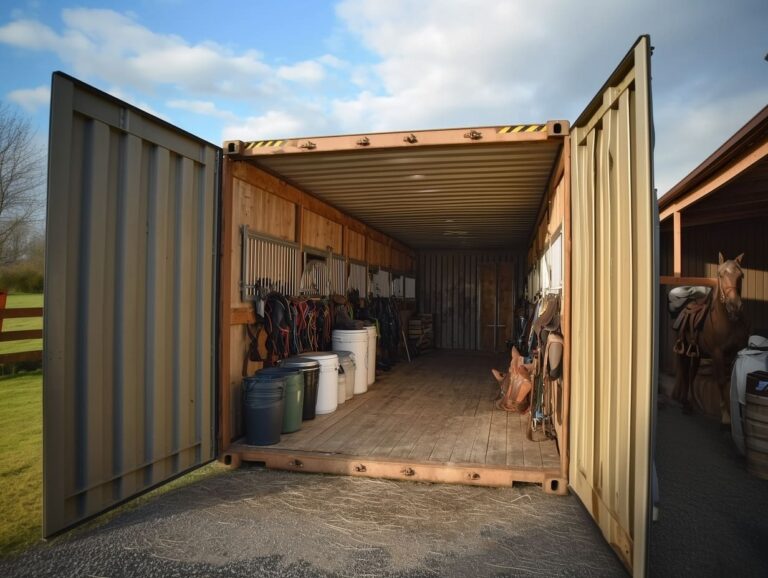
Instead of extending an existing barn, the container was placed nearby and converted into a dedicated tack room. This created a secure, dry environment for equipment that could be used almost immediately.
Farm work does not stop for bad weather. Snow, rain, wind, and rapid temperature swings are part of everyday life in many regions. Shipping containers are engineered for exactly these conditions.
Constructed from Corten steel, containers are designed to resist corrosion and maintain their structural integrity for decades. Unlike wood frame sheds, they do not warp, rot, or deteriorate as quickly over time.
For this farmer, that meant peace of mind knowing valuable tack and tools were protected year round, regardless of weather conditions.
Rodents are a persistent issue on farms. Feed, hay, and animal activity naturally attract pests, and once rodents access a storage area, damage can happen fast.
Shipping containers offer a major advantage here. Solid steel walls and tight sealing doors significantly reduce entry points, making them far more rodent resistant than traditional farm structures.
In this use case, eliminating rodent damage was one of the most immediate benefits of switching to container based storage.
One of the most important considerations when using a shipping container for farm storage is size. A 20 foot container provides roughly 160 square feet of interior space, which is often ideal for a compact tack room, tool storage, or equipment organization.
For farms that require more room, a 40 foot container offers double the space at approximately 320 square feet. This makes it well suited for larger tack rooms, combined feed storage, or multi use farm storage areas.
In this case, the initial container solved the immediate need, while leaving room to scale up later with additional units as storage demands grow.
One of the biggest advantages of using shipping containers is flexibility. This was not just a short term fix, but part of a longer term storage strategy.
Future plans include adding another container, installing a prefabricated adjustable roof system, and creating elevated hay storage above the container space.
Because containers are modular, expansion is far simpler than modifying traditional buildings. Units can be added or repositioned without disrupting existing structures.
This farm use case reflects a broader trend across rural properties. Shipping containers are increasingly being used as:
For many landowners, containers provide the ideal balance between durability, speed, and cost. Instead of waiting months for construction, a container can be delivered and ready for use in a short timeframe.
Many people assume container conversions require complex renovations. In reality, most farm applications need only basic upgrades to be highly functional.
In this use case, practical additions such as shelving, lighting, ventilation, and durable flooring were enough to create a highly effective tack room. The focus was on function and longevity rather than decorative finishes.
There is a natural alignment between the work of a farrier and the strength of a shipping container. Both are built to endure pressure, resist the elements, and perform reliably over time.
This use case demonstrates how choosing the right storage solution can simplify daily operations, protect valuable assets, and support future growth without unnecessary complexity.
If you are facing storage limitations, high construction costs, or ongoing issues with moisture and pests, a shipping container may be the right solution for your property.
You can shop our selection of shipping containers to find options that suit agricultural, equestrian, and rural storage needs.
This farm use case shows how a Corten steel shipping container can become much more than a storage box. With minimal modification, it became a secure tack room, a rodent resistant safeguard for valuable equipment, and a scalable foundation for future expansion.
For farmers, ranchers, and equestrian professionals looking for strength, protection, and practicality, shipping containers continue to prove their value one use case at a time.