
30 Day Money Back Guarantee
Rated 5.0 on Google Reviews
Call Now +1 (866) 589-9392
Delivery Across North America 🚚
30 Day Money Back Guarantee
Rated 5.0 on Google Reviews
Call Now +1 (866) 589-9392
Delivery Across North America 🚚
Moving containers have become one of the most popular alternatives to traditional moving trucks and full-service movers over the past decade, and for good reason. They combine the flexibility of self-service packing with the convenience of professional transport, without forcing you to drive a rental truck yourself or commit to a rigid moving-day schedule.
If you’re planning a move and trying to figure out whether a moving container makes sense for your situation, this guide covers exactly what a moving container is, how the process works from start to finish, and what to expect at each step.
A moving container is a portable storage unit delivered directly to your home, which you pack at your own pace, and which is then picked up and transported to your new location by the moving company. Unlike a rented moving truck that you drive yourself, or a full-service move where a crew packs and drives everything for you, a moving container splits the difference: you control the packing, the company handles the driving.
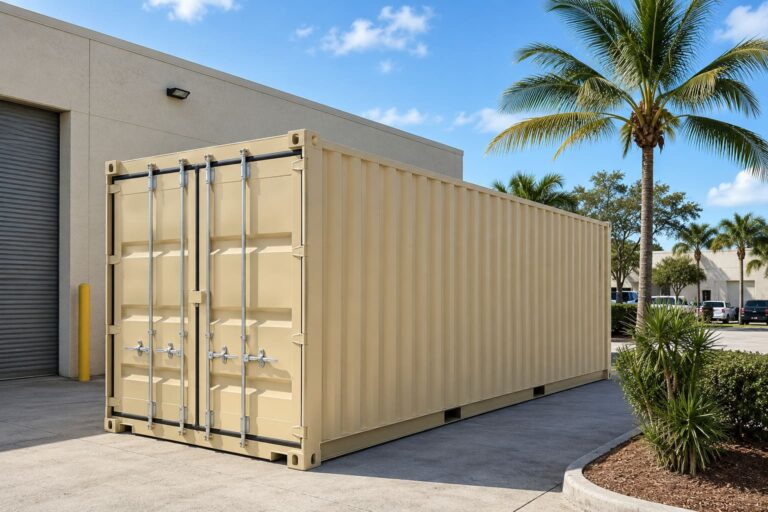
Moving containers are typically weatherproof steel units, similar in construction to a standard shipping container but sized and configured specifically for household moving and short-to-medium term storage. They’re delivered to your driveway or curb, loaded over the course of a day or several days, then picked up and either transported directly to your new address or held in a secure storage facility until you’re ready for delivery.
The process follows a consistent sequence regardless of the distance or timeline involved, though the details can be adjusted to fit your specific move.
You start by booking your container, providing your origin address, destination address, and preferred delivery and pickup dates. Most moving container companies offer some flexibility in scheduling, since you’re not tied to a single moving-day time slot the way you are with a traditional moving crew.
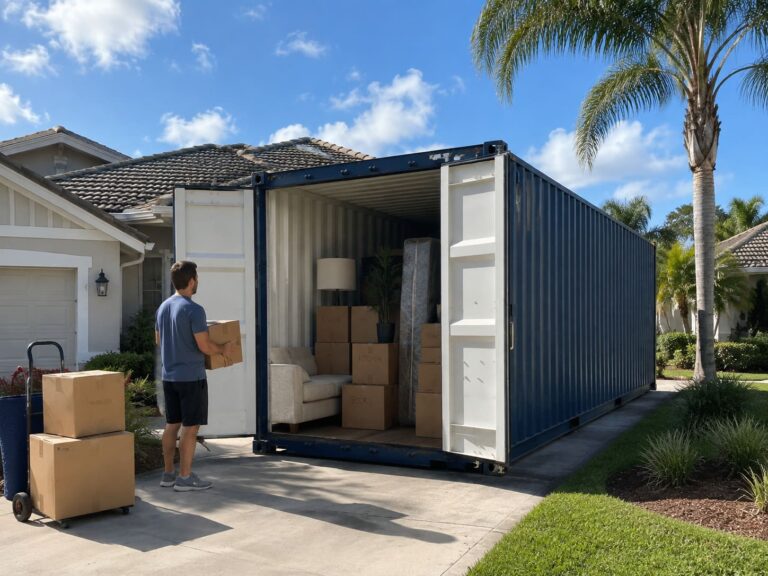
The container arrives at your home and is placed in your driveway, on the street with a permit if required, or in another accessible location on your property. The container is positioned so the doors are easily accessible for loading, and it stays there for as long as your booking allows.
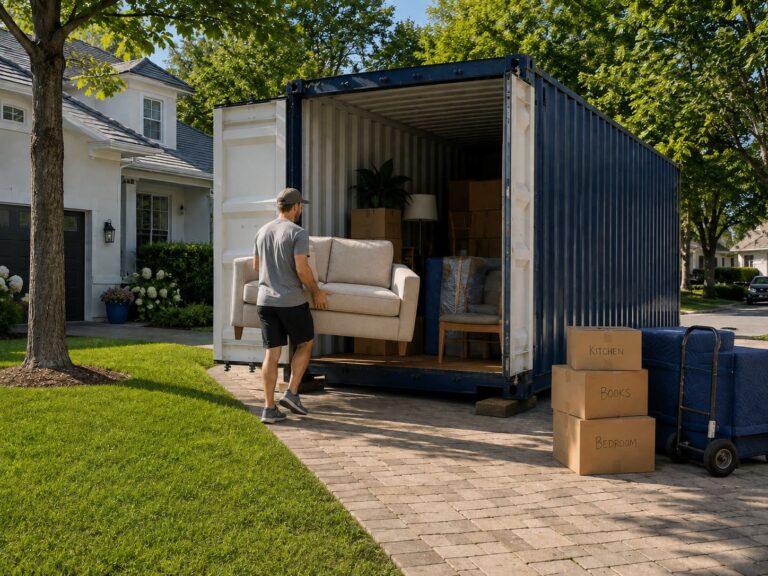
This is the core advantage of the moving container model. Instead of packing everything in a single frantic day before a moving truck and crew arrive, you load the container over the timeline that works for you, whether that’s a single weekend or spread across a week or more depending on what your booking includes. You can take breaks, reorganize, and load room by room without the pressure of a moving crew waiting on the clock.
Once you’ve finished loading and secured the contents, the container is picked up and transported to your destination. Depending on the distance and your specific timeline, the container may go directly to your new address or be held at a secure storage facility if you need a gap between move-out and move-in dates.
The container arrives at your new address on the date you’ve arranged, and you unload it at your own pace, just as you loaded it. Once you’re finished, the container is picked up and the process is complete.
Understanding how moving containers compare to the other common moving methods helps clarify which approach fits your specific situation.
A rental truck requires you to drive the vehicle yourself, which means navigating an unfamiliar, often oversized vehicle, potentially over long distances or through unfamiliar cities. It also means the entire move happens in a single continuous push: load, drive, unload, typically all in the same day or two.
A moving container removes the driving entirely. You load on your schedule, and someone else handles the transport. For moves of any significant distance, or for anyone uncomfortable driving a large rental vehicle, this is a meaningful advantage. The tradeoff is that a moving container generally costs more than a basic truck rental, since you’re paying for the transport service in addition to the container itself.
Full-service movers handle everything: packing, loading, driving, and unloading, typically completed within a defined moving-day window. This is the most hands-off option but also generally the most expensive, and it requires your entire move to happen on a schedule dictated by the moving crew’s availability.
A moving container gives you more control over your timeline and is typically less expensive than a full-service move, since you’re providing the labour for packing and unloading. The tradeoff is that you’re doing the physical work yourself, or need to arrange your own help, rather than having a professional crew handle it.
A traditional storage unit requires you to transport your belongings to the facility yourself, typically using a truck or multiple vehicle trips. A moving container comes to you, eliminating the transport step entirely for both the initial move-in and any eventual retrieval. If you need storage between a move-out and move-in date, many moving container providers can hold your container at their facility for exactly that purpose, combining the moving and storage functions into a single service.
Moving containers suit a wide range of situations, but they tend to be a particularly strong fit for a few common scenarios.
Moving container pricing depends on the size of container you need, the distance between your origin and destination, how long you need the container for loading and unloading, and whether any storage time is required between pickup and final delivery. Pricing is generally positioned between a basic truck rental and a full-service move, reflecting the combination of self-packing convenience and professional transport.
The most accurate way to understand your cost is to get a quote based on your specific move details rather than relying on general estimates, since distance and container size have the largest impact on total price.
Moving container sizing follows a similar logic to general storage container sizing, but the right choice depends on the size of your home and how much you’re moving.
A smaller container works well for studio and one-bedroom apartments, partial moves, or situations where you’re only moving a portion of your belongings. A larger container is appropriate for two to three-bedroom homes with a full household of furniture and belongings. For larger homes, multiple containers may be the right approach, allowing you to organize your move by room or category across separate units.
If you’re unsure what size fits your situation, providing details about your home size and approximate inventory when requesting a quote allows for an accurate size recommendation before you commit.
A few practical steps make the loading and unloading process significantly smoother.
Load heavier items first and along the floor, with lighter and more fragile items loaded on top and secured so they don’t shift during transport. Distributing weight evenly across the container floor helps maintain stability during transport.
Use moving straps, rope, or tie-downs to secure furniture and prevent shifting during transport. Fill gaps between items with soft materials like blankets or pillows to reduce movement and cushion contact between items.
Label boxes by room and general contents so unloading at your new address is faster and more organized. This is particularly useful if your container will be in storage for a period before final delivery, as you’ll want to remember what’s where when you eventually unload.
Make sure the delivery location, both for the initial drop-off at your current home and the final delivery at your new address, has adequate space and access for the delivery vehicle. Narrow driveways, low overhead clearances, or street parking restrictions should be communicated in advance so the delivery can be planned accordingly.
This depends on your specific booking and the provider’s policies. Most moving container services offer a defined loading window as part of the standard booking, with the option to extend if you need additional time. If your move-out and move-in dates don’t align, the container can typically be picked up and held in storage until you’re ready for final delivery, rather than needing to remain at your home for the full gap.
Generally, yes. Because you’re handling the packing and unloading yourself rather than paying for a full crew’s labour, moving container services typically cost less than full-service movers while still eliminating the need to drive a rental truck yourself. The exact cost comparison depends on your specific move distance, container size, and timeline, so getting quotes for both options based on your actual move details is the best way to compare.
Yes. Many moving container providers offer storage as part of their service, allowing your container to be held securely at a storage facility for any length of time between pickup from your old address and delivery to your new one. This is particularly useful for moves where your move-out date comes before your new home is ready.
Capacity depends on the container size you book. Smaller containers suit studio and one-bedroom moves or partial household moves, while larger containers accommodate a full two to three-bedroom household. For larger homes, using multiple containers is common, which also allows you to organize your move by room or category. Providing your home size and general inventory when booking helps ensure you reserve the right size and avoid needing a second container after the fact.
Driveway placement typically does not require a permit, since the container is on private property. Street placement is more likely to require a permit depending on your municipality, particularly if the container will occupy a parking space or affect traffic flow for an extended period. Check with your local municipality if you don’t have driveway space available and will need to place the container on the street.
Hazardous materials, flammable liquids, perishable food items, and certain valuables such as important documents, jewelry, and irreplaceable items are generally not recommended or permitted for container transport. It’s best to keep these items with you during the move rather than packing them into the container. If you’re unsure whether a specific item is appropriate for container transport, ask your provider directly before loading day.