
30 Day Money Back Guarantee
Rated 5.0 on Google Reviews
Call Now +1 (866) 589-9392
Delivery Across North America 🚚
30 Day Money Back Guarantee
Rated 5.0 on Google Reviews
Call Now +1 (866) 589-9392
Delivery Across North America 🚚
Rental businesses that serve outdoor recreation have a unique problem. They need a secure place to store expensive gear, a counter to serve customers, and a location right where the action is: at the bottom of a ski hill, beside a bike trail, on a lakeshore, or steps from the beach. Those spots rarely have a building available, and constructing one for a business that may only operate a few months a year is hard to justify.
A shipping container solves that problem. It can be dropped exactly where customers need it, fitted with a service window and racks, locked up tight at night, and moved when the season changes. This guide covers how to set up a shipping container rental shop for ski, snowshoe, bike, kayak, paddleboard, and beach gear, including layout, modifications, security, and seasonal planning.
Rental fleets are valuable. Skis, e-bikes, kayaks, and paddleboards add up quickly, and outdoor locations are often unattended overnight. A steel container with locking cargo doors and a lock box is far harder to break into than a tent, trailer, or wooden shed. Gear stays inside, protected from theft and weather, without needing to be hauled back to a warehouse every evening.
One container can do double duty: the front becomes a service counter where staff check customers in and out, while the back and walls hold racks of equipment. A 20ft container can run a small operation, and a 40ft container can support a full rental fleet with room for repairs and a small retail display.
A container can be placed at a trailhead parking lot, a park pavilion, a marina, a campground, a resort, or a beach access point, often in locations where permanent construction wouldn’t be allowed or practical. Being right at the point of use is a huge advantage for walk-up rentals.
Many rental businesses operate seasonally or shift locations with demand. A container can stay in place year-round, be closed up during the off-season, or be relocated to a different site when the season changes. That flexibility is difficult to get from any permanent building.
Buying and outfitting a container typically costs far less than constructing a permanent rental shop, and the container retains resale value if the business changes direction.
Smaller ski hills, cross-country ski centres, snowshoe trails, and winter parks often need rental capacity without the cost of a full lodge expansion. A container at the base of the hill or the trailhead can store skis, boots, poles, snowboards, and snowshoes in organized racks, with a service window for fitting customers.
Winter operations need a few extras: insulation and heat to keep staff comfortable and boots warm, boot dryers, rubber floor mats for melting snow, and a covered area in front of the service window so customers aren’t waiting in falling snow.
Trail networks, waterfront paths, tourist districts, and campgrounds are ideal spots for bike rentals. A container can hold wall-mounted bike racks, helmet storage, a small repair bench, and, for e-bikes, a dedicated charging station. Bike rentals can often run year-round in warmer markets and from spring to fall in colder ones.
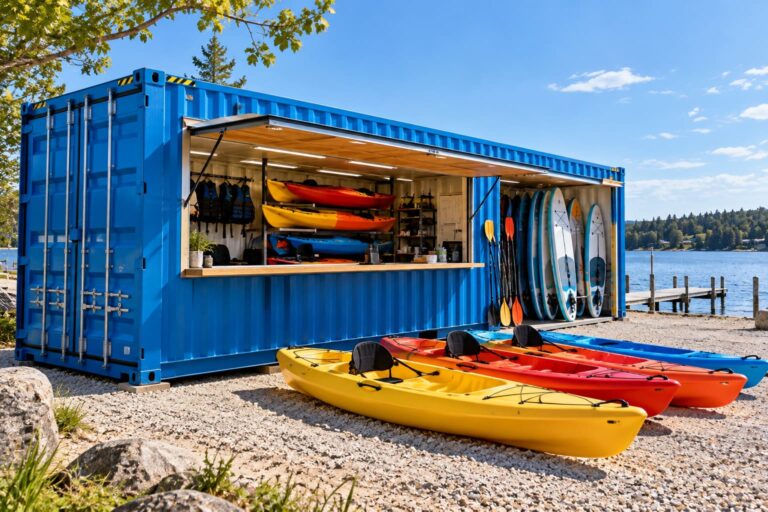
Lakes, rivers, marinas, and coastal launch points are perfect for paddle sports rentals. A 40ft container can store kayaks and paddleboards on wall-mounted cradles or tiered racks, with paddles, life jackets, and dry bags organized on hooks and shelves. Placement close to the water reduces the distance customers carry equipment.
Water-based rentals benefit from drainage-friendly flooring, ventilation to dry wet gear, and hose bibs or rinse stations outside the container.
Beach chairs, umbrellas, cabanas, coolers, snorkel gear, and boogie boards are ideal container inventory. Beachfront and resort operators use containers as gear depots that open each morning and lock up at night. In coastal environments, corrosion-resistant coatings and regular rinsing help the container hold up to salt air. For more on coastal considerations, see our guide on buying a shipping container in Florida.
Rods, tackle, augers, ice shelters, and heaters can be rented from a container placed at a lake access point. Winter ice fishing rentals pair well with snowshoe and cross-country ski rentals at the same location.
Resorts, campgrounds, and large events use containers to store and charge carts, scooters, and other rentable equipment overnight.
One of the smartest uses of a container is running two businesses from the same unit. A container that rents kayaks and paddleboards in summer can switch to snowshoes and cross-country skis in winter by swapping racks and inventory. That keeps the container productive all year and spreads its cost across two revenue streams.
| Container Size | Best For | Typical Setup |
|---|---|---|
| 20ft | Small operations, single gear type, tight sites | Service window at one end, racks along both walls |
| 40ft | Larger fleets, kayaks and paddleboards, mixed gear | Service area at the front, storage zones along the length, small repair bench |
| 40ft High Cube | Tall racks, stacked boards, overhead storage | Multi-level racking with extra headroom for staff |
Long items such as kayaks, canoes, and stand-up paddleboards need length, which makes a 40ft container the practical choice. Skis, bikes, and beach gear fit well in a 20ft unit for smaller operations. For a full size comparison, see our guide on 20ft vs. 40ft shipping containers.
Plan the layout around how customers move: arrive, check in, get fitted, pick up gear, and return it. A service window or counter at the front keeps customers outside while staff retrieve gear from inside. For businesses that fit customers, such as ski and snowboard rentals, a walk-in setup with a fitting bench may work better.
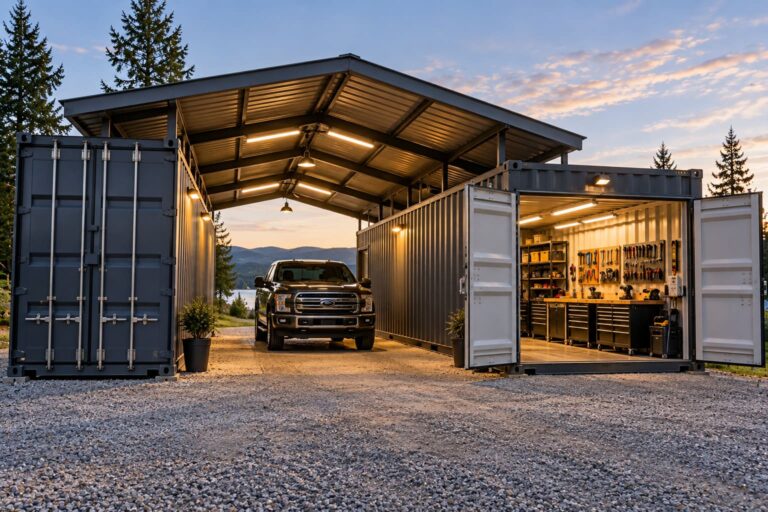
A service window cut into the side or end of the container turns it into a storefront. Options include roll-up steel shutters for security, hinged awnings that open upward to create shade and rain cover, and fold-down counters that provide a serving surface when open. Openings should be framed with welded steel to keep the walls strong.
Cargo doors are heavy and slow to open for every customer. Adding a standard steel personnel door gives staff quick access, while the cargo doors can stay closed or be opened during busy periods for moving large equipment.
Racks can be bolted to framing or to brackets attached to the container wall, so you don’t need to weld everything directly to the steel.
LED interior lighting makes inventory easy to find and shows gear well to customers. Exterior lights improve security and allow operation in early mornings and evenings. Power is needed for POS systems, boot dryers, e-bike charging, and heating or cooling. Remote sites can use roof-mounted solar panels with a battery bank. Electrical work should be installed by a licensed electrician to local code.
Wet gear from snow, rain, and water sports can create humidity, odours, and mildew inside a closed container. Roof vents, wall louvres, exhaust fans, or a dehumidifier keep air moving and help gear dry between rentals.
Winter rentals benefit from an insulated container with a small heater so staff can work comfortably and boots stay warm. Summer rentals in hot climates may need insulation, a light-coloured roof, and a small air conditioner. For more on insulation options, see our guide on building inside a shipping container.
Rubber mats, textured vinyl, or sealed coatings handle wet boots, sand, and dripping gear better than bare wood. Drainage-friendly mats help water drain away from the walking surface.
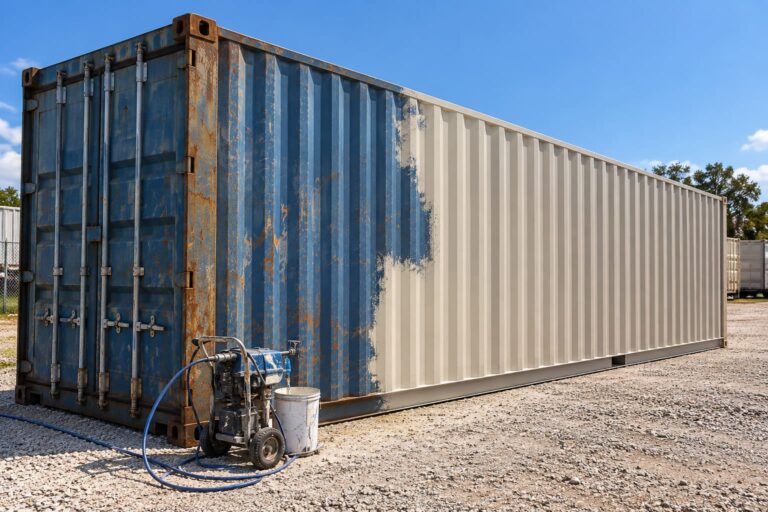
A rental shop has to be easy to find. Paint the container in bright brand colours, add large signage, and display rental prices clearly. For tips on choosing paint and prepping the surface, see our guide on painting a shipping container.
Awnings, pergolas, or attached canopies give customers shelter while they wait and create an outdoor fitting or staging area. In winter, a covered area keeps snow off customers and equipment. In summer, shade makes the whole operation more comfortable.
Many operators leave the container at the same site all year. During the off-season it becomes secure storage for the rental fleet, which avoids moving gear to a separate warehouse.
If your summer and winter locations are different, a container can be moved with a tilt-bed or flatbed truck. Plan relocation before the season starts: confirm access at the new site, secure the gear inside or remove it, and disconnect any power. Moving a container twice a year is often still cheaper than maintaining two permanent buildings.
The best locations have steady foot traffic, visibility, parking, and direct access to the activity, whether that’s a trailhead, launch point, ski hill, or beach. The site also needs to be accessible for a delivery truck and firm and level enough to support the container.
Many container rental shops operate on land owned by parks, municipalities, marinas, resorts, campgrounds, or private landowners. Common arrangements include site leases, revenue-sharing agreements, and concession contracts. Partnering with an existing destination can provide a built-in customer base.
A container used as a customer-facing business may require a business licence, a zoning or land use permit, and in some cases a building permit, especially if it has electrical service or a structure attached. Public parks and waterfronts often have their own concession rules. Rental businesses also need liability insurance and signed customer waivers. Check with your municipality and the landowner before buying a container.
For a customer-facing rental shop where appearance matters, a new one-trip container provides a clean exterior and interior that’s easier to brand and finish. A new 20ft container works well for compact rental stands, and a new 40ft container or new 40ft high cube container suits larger fleets and long boats or boards.
If you’re on a tighter budget or using the container mainly for back-of-house storage, a cargo-worthy used 20ft container or used 40ft container is a cost-effective option, especially if you plan to paint and brand it. For more on the differences, see our guide on new vs. used shipping containers.
Ready to set up your rental shop? Get a quote or use our live rate tool to price a container delivered to your site.
Yes. Shipping containers are widely used as rental shops for skis, snowshoes, bikes, kayaks, paddleboards, and beach gear. A container can be fitted with a service window, racks, lighting, and security features to work as both a storefront and secure storage. Depending on your location, you may need a business licence and permits.
A 40ft container is usually best for kayaks, canoes, and stand-up paddleboards because it provides the length needed to store long boats and boards on wall-mounted racks. A 40ft high cube adds extra height for more racking tiers.
Skis and snowboards are typically stored in vertical slot racks along the walls, sorted by length. Bikes are hung on wall hooks or vertical racks to save floor space. Boots, helmets, and accessories go on shelving or in cubbies organized by size.
Combine a lock box over the main padlock, roll-up steel shutters on service windows, interior cable locks for high-value items, motion lighting, cameras, and an alarm system. Consistent inventory tracking also helps identify losses quickly.
Yes. A container can be relocated with a tilt-bed or flatbed truck. Many operators move a container between a summer location such as a beach or lake and a winter location such as a ski hill or trail. Plan site access and disconnect utilities before each move.
Ventilation is key. Install roof vents or wall louvres, use exhaust fans or a dehumidifier, dry gear before storing it, and use drainage-friendly floor mats. Leaving doors open on dry days during the season and thoroughly drying the container before off-season storage also helps.
Often, yes. Requirements depend on the municipality and landowner, but a customer-facing container business may need a business licence, a zoning or land use permit, and possibly a building or electrical permit. Parks, beaches, and marinas often have their own concession requirements. Confirm with local authorities before setting up.
Yes. A container can rent kayaks, paddleboards, or bikes in summer and switch to skis, snowshoes, or ice fishing gear in winter by changing racks and inventory. This keeps the container earning revenue year-round.