
30 Day Money Back Guarantee
Rated 4.9 on Google Reviews
Call Now +1 (866) 589-9392
Delivery Across North America 🚚
30 Day Money Back Guarantee
Rated 4.9 on Google Reviews
Call Now +1 (866) 589-9392
Delivery Across North America 🚚
Film and television production is one of the most logistically demanding industries in existence. A single production requires the movement, storage, and rapid retrieval of thousands of individual items across departments that each have their own inventory, workflows, and security requirements. On any given shooting day, the grip and electric department, art department, wardrobe, props, set dec, camera, and production office are all running simultaneously and all need their assets organized, accessible, and protected.
Shipping containers have become a standard part of the production infrastructure on mid-to-large scale film and television productions across North America, used for on-location equipment storage, departmental organization, and secure overnight containment of assets that cannot be left unprotected at an exterior location.
This guide covers how productions use containers throughout their shoot, what size and condition suits different departmental needs, and what location managers and production coordinators should consider when integrating containers into a production’s logistics plan.
Production storage is unlike almost any other commercial storage scenario. The volume of assets is enormous, the need for organized and rapid access is constant, the locations change frequently, and the consequences of missing or damaged equipment are measured in thousands of dollars of production downtime per hour.
Productions shooting on location away from a studio backlot need to bring their own infrastructure. A location that works visually may offer nothing in the way of storage, security, or shelter for the dozens of equipment packages and departmental carts that arrive on the first day of shooting. The production’s job is to create that infrastructure out of whatever can be brought to the location.
Containers address this need in a format that is immediately deployable, standardized, and secure. A container delivered to a location base camp the day before production begins is ready to receive equipment the moment it arrives. At the end of the shoot, it is locked and either held for the next location or returned to a staging facility.
Each department on a production has distinct storage requirements, and containers adapt to serve most of them effectively.
The grip and electric department manages the largest and heaviest inventory on any production: lighting fixtures, distribution equipment, generators, grip hardware, stands, flags, cabling, and rigging equipment. This inventory is typically organized across multiple package trucks, but supplemental container storage at base camp allows the department to keep backup equipment, frequently needed consumables, and long-term rentals organized and accessible without rotating through the trucks.
A 40ft container at base camp serves as a depot for grip and electric that reduces the time spent sourcing additional equipment from a rental house during the shoot. Items used on multiple locations across a long production can be held in the container rather than returned and re-rented, which reduces both cost and logistics complexity.
The art department and set decoration team manage a constantly evolving inventory of set dressing items, props, construction materials, paint, and fabricated elements that move between the production office, construction shop, and active set. During production, dressed items that are not currently on set need to be held in a secure, organized environment where they can be retrieved quickly when needed.
Containers serve as on-location holding areas for set decoration inventory, keeping dressed items protected and organized without requiring a return trip to the art department’s main facility. For productions with large standing sets or recurring locations, a container near the set holds the specific dressing for that environment, reducing setup and strike time when the production returns.
The wardrobe department manages the full costume inventory for every character across the entire production, which on a large series can represent thousands of individual garments and accessories. On-location wardrobe storage requires a clean, dry, organized environment where costumes can be hung, maintained, and accessed by department personnel without risk of damage from weather or contamination.
Containers used for wardrobe storage are typically fitted with interior hanging rails, shelving for accessories and footwear, and sometimes a small work area for quick alterations. A climate-controlled container is worth considering for wardrobe in extreme heat or cold conditions, as some period or specialty costumes are sensitive to temperature and humidity exposure.
The props department is responsible for every object that actors interact with on screen, which on a complex production can mean hundreds of individual items ranging from period-accurate small objects to hero props that have been custom fabricated at significant cost. Security is a primary concern for the props department, as high-value and irreplaceable items cannot be left in an open or unsecured environment overnight.
A dedicated props container at base camp keeps the department’s full inventory secure, organized by category or scene, and accessible for daily pulls without requiring a return to a more distant holding facility. Lock boxes and upgraded container locks provide the additional security that high-value prop inventories warrant.
Camera equipment is among the highest-value inventory on a production. A full camera package including bodies, lenses, support equipment, and accessories can represent millions of dollars of rented or owned equipment. At the end of each shooting day, camera packages that are not going back to the rental house need a secure overnight storage environment.
A container at base camp designated for camera and specialty equipment overnight storage addresses this need without requiring the DIT or camera assistant to transport sensitive equipment off-location each evening. Climate-controlled storage is worth considering for productions in environments with extreme temperature variation, as some lens and electronics packages are sensitive to rapid thermal cycling.
The production office and location department use containers as mobile office infrastructure at locations where permanent facilities are not available. A container fitted with power, lighting, and basic furniture serves as a production office, location coordinator base, or talent holding area that can be set up at any exterior location regardless of what permanent infrastructure is available on site.
Location departments also use containers to store their own equipment inventory: signage, traffic control equipment, communication gear, safety supplies, and the material infrastructure required to manage a filming location. A dedicated location container that travels with the production from location to location keeps this inventory organized and avoids the repeated packing and unpacking of equipment between shoots.
Base camp is the organizational hub of an on-location production, typically positioned as close to the shooting location as logistics allow. It houses the production’s trucks, trailers, and support infrastructure and is the point from which equipment and personnel deploy to set each day.
Containers at base camp supplement the truck fleet by providing additional static storage capacity for equipment that is not needed on set every day but needs to remain on location and secure. They also serve as a stable fixed point in a base camp that may otherwise be entirely vehicle-dependent, providing a structure that remains in place through multiple company moves without requiring repositioning on the same location.
The production’s locations department coordinates container placement at each base camp, working with the location owner or authority to confirm that adequate space and access are available for delivery and placement. On remote or constrained locations, a 20ft container’s smaller footprint and shorter delivery truck requirement make it more practical than a 40ft unit.
Production departments typically differentiate between the two sizes based on the volume of inventory they manage and the space available at base camp locations.
A 20ft container is the right choice for individual departmental storage where the inventory is focused and the location footprint is constrained. The props department, wardrobe, or camera department each have a defined inventory that often fits within a 20ft unit. Single-department containers are easier to position at constrained base camps and can be placed closer to the department’s primary work area.
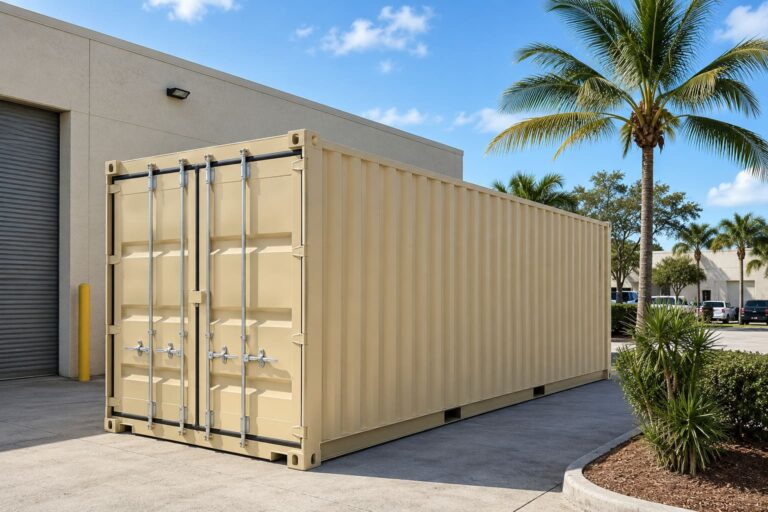
A used 20ft container in cargo-worthy condition is the standard choice for production storage applications. The cosmetic condition of a used container has no bearing on its ability to keep equipment secure and dry, and the lower cost relative to a new unit is meaningful across a production that may need multiple containers simultaneously.
A 40ft container is appropriate for departments with large inventories, for combined storage that serves multiple departments, or as a general production holding container at base camp that houses equipment from multiple sources. Grip and electric and set decoration tend to be the departments most likely to fill a 40ft container.
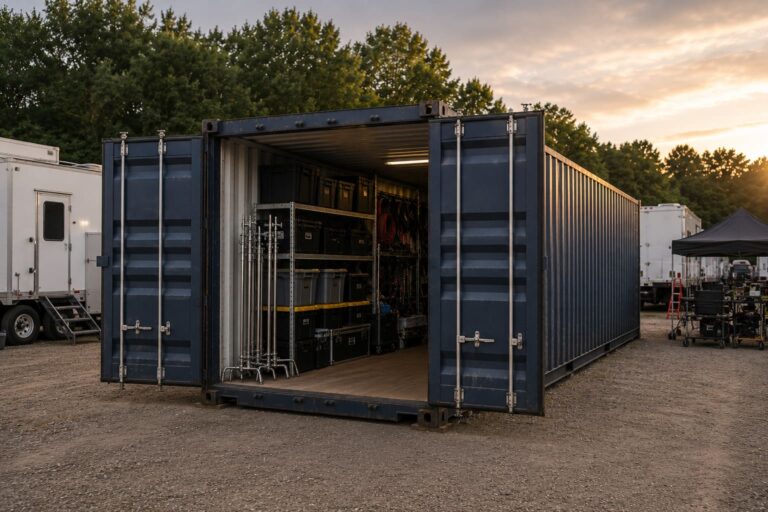
A used 40ft container in cargo-worthy condition provides the volume and organizational depth that high-inventory departments require. Interior racking, shelving, and hanging systems added to a 40ft container transform it from a raw storage space into a functional departmental storage facility that supports efficient daily operations.
Ontario is one of the most active production markets in North America, with Toronto and the surrounding GTA hosting a volume of film and television production that regularly ranks among the busiest in the continent. Productions shooting in Ontario have strong access to container inventory and delivery infrastructure, with depots throughout the GTA that can service base camp placements across the region on short notice.
The intersection of production logistics and Ontario’s commercial container market means that productions can procure or rent containers for a shoot and have them delivered to location with relatively short lead times, which aligns well with the often compressed pre-production timelines that characterize film and television scheduling. For more on the broader container market serving Ontario businesses and productions, the article on shipping container storage solutions for Ontario businesses covers the regional market context in detail.
A few operational considerations apply specifically to container use in production contexts that differ from standard commercial or industrial storage.
Production schedules operate on tight timelines that leave little room for delivery delays. Containers needed for day one of principal photography must be confirmed, scheduled, and delivered before the first equipment trucks arrive at base camp. Coordinating container delivery as part of pre-production logistics planning, rather than treating it as a last-minute arrangement, reduces the risk of a critical delivery conflict with a shooting schedule.
Film locations are often selected for their visual qualities rather than their infrastructure, which means containers are sometimes needed at locations with restricted access, soft ground, weight-limited roads, or other delivery challenges. Communicating site conditions to the delivery team in advance allows for appropriate truck selection and positioning planning before the delivery date.
Standard container cam lock hardware is adequate for most situations, but productions storing high-value equipment overnight at exterior locations often add lock boxes, secondary locking bars, and security seals that make unauthorized access more difficult and provide a tamper indicator. Some productions use padlock seals with serial numbers that allow the first person to open the container each morning to confirm the seal is intact before entering.
A container used effectively for production storage is organized with the same rigor as any other departmental system. Labels, bins, hanging systems, and shelving that reflect the department’s internal organization system allow equipment to be retrieved quickly without digging through an undifferentiated pile. The time spent organizing a container during load-in pays back in retrieval speed throughout the production.
Production departments storing sensitive equipment should verify door seal integrity before accepting a delivered container and placing high-value inventory inside. A quick light test, standing inside with doors closed to check for any pinhole perforations, and a door gasket inspection take a few minutes and confirm that the container will protect its contents through overnight and weekend holds.
Some productions rent containers for the duration of a shoot, while others purchase them outright. The right approach depends on the production’s budget structure, the length of the shoot, and whether the production company has ongoing storage needs beyond the specific project.
For long-running series productions or production companies with multiple active projects, purchasing containers outright is often more cost-effective than renting over time. Owned containers can be reused across multiple productions, held at a staging facility between shoots, and eventually resold when no longer needed. They also give the production company direct control over container condition and modification.
For single productions with a defined end date, renting may be the more appropriate structure, as it eliminates the need to manage resale or storage of the container after the production wraps. Understanding the total cost of both approaches relative to the production’s specific timeline and future plans is the best basis for the decision.
Productions with specific delivery requirements, multiple containers across several locations, or tight scheduling constraints benefit from a direct conversation before placing an order. The get a quote form is the most efficient way to outline your production’s requirements and receive a tailored response. For a full view of available sizes and current inventory, the container shop provides a starting point for understanding options across new and used formats.
Shipping containers provide a secure, weatherproof, immediately deployable storage solution for productions shooting at exterior locations where permanent infrastructure is not available. They protect high-value equipment inventories overnight and through weekends without requiring the production to transport everything off-location each day. Their standardized dimensions fit within the organized base camp structure that most productions use, and they can be delivered, positioned, and ready to receive equipment within a short window before principal photography begins.
Both 20ft and 40ft containers are used on productions, with the choice determined by the department’s inventory size and the space available at base camp. Individual departmental containers, such as those used for props, wardrobe, or camera equipment, are often 20ft units. Departments with larger inventories, such as grip and electric or set decoration, more frequently use 40ft containers. Some productions use a mix of sizes, with a large 40ft unit as a general holding container and smaller 20ft units for specific departments with focused storage needs.
Both models are used, and the right approach depends on the production’s structure and plans. Renting is common for single productions with defined end dates, as it avoids the need to manage resale or storage after the shoot wraps. Purchasing makes more sense for production companies with ongoing projects or long-running series, where the containers can be reused across multiple shoots and the total cost of ownership is lower than repeated rental fees over time. Some production companies maintain a small fleet of owned containers for ongoing use and rent additional units as needed for larger productions.
Containers are delivered by tilt-bed or flatbed truck and offloaded at the base camp location. The delivery requires adequate vehicle access, a firm surface for offloading, and enough space for the truck to position and release the container at the intended location. Locations departments typically coordinate container delivery as part of pre-production location logistics, confirming access conditions and scheduling delivery to coincide with the base camp setup window before principal photography begins.
Yes. Containers converted for use as field offices are used across the production industry for location coordinator bases, production offices, and departmental work spaces at locations where permanent office facilities are not available. A basic conversion adds power, lighting, and interior fittings appropriate for office use. More complete conversions include insulation, climate control, windows, and custom interior layouts tailored to specific production office workflows. The conversion scope depends on how long the office will be in use and what the production’s budget allows for the infrastructure.
Standard container cam lock hardware and a heavy-duty padlock provide baseline security for most production storage situations. Productions storing particularly high-value inventory such as camera packages, specialty lenses, or hero props often add lock boxes that cover the padlock and make cutting more difficult, secondary locking bars that prevent the door from being opened even if the primary lock is defeated, and numbered security seals that provide a tamper indicator allowing the first person to open the container each morning to confirm it has not been accessed. For productions shooting at high-risk locations, additional measures such as overnight security personnel or alarm systems may be warranted.
As early in pre-production as the shoot schedule allows. Container delivery requires scheduling a truck and confirming inventory availability, both of which become more constrained as the delivery date approaches. For productions in the GTA and major urban markets with strong container inventory, a week or more of lead time is generally sufficient for straightforward deliveries. For remote locations, unusual site conditions, or multiple containers being delivered across several locations on a tight schedule, more lead time reduces the risk of a logistics conflict with the shooting schedule. Communicating the production’s full container needs during pre-production planning allows delivery to be coordinated as a scheduled part of the location setup process rather than arranged at the last minute.