
30 Day Money Back Guarantee
Rated 5.0 on Google Reviews
Call Now +1 (866) 589-9392
Delivery Across North America 🚚
30 Day Money Back Guarantee
Rated 5.0 on Google Reviews
Call Now +1 (866) 589-9392
Delivery Across North America 🚚
Landscaping is an equipment-intensive business. Mowers, trimmers, blowers, hand tools, irrigation supplies, fertilizer, mulch, seasonal plantings, and small machinery all need somewhere to live between jobs and over winter. For many landscaping companies, the answer has shifted away from rented storage yards and crowded shop floors toward shipping containers positioned at the locations that make the most operational sense.
This guide covers how landscaping and grounds maintenance companies are using containers for job site storage, what size and condition works best, and what to think through before adding a container to your operation.
Landscaping operations run across multiple job sites simultaneously. Equipment and materials move constantly, and the distance between a central shop and an active job site introduces daily inefficiency when crews have to retrieve tools or supplies rather than having them on location.
Renting storage space near active jobs is expensive and not always available in the right locations. Leaving equipment on job sites in the open creates security exposure and weather damage risk. Hauling everything back to a central yard at the end of each day adds drive time that eats into productive hours.
A container positioned on or near a job site eliminates most of these problems. It provides a lockable, weather-resistant storage point that keeps equipment secure and accessible without requiring daily retrieval trips.
The most common applications fall into a few distinct categories depending on the size and nature of the landscaping operation.
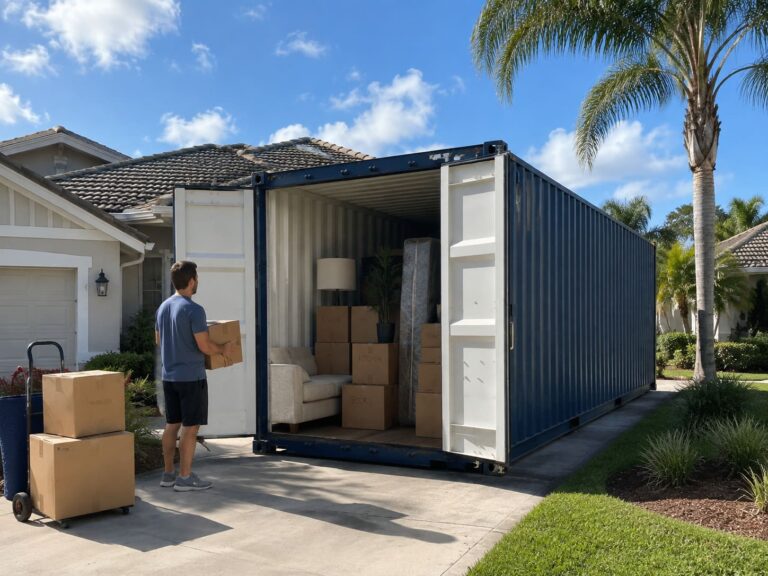
For larger landscaping projects that run for weeks or months, such as commercial property maintenance contracts, municipal grounds work, or large residential development landscaping, a container placed at the site gives crews on-site access to everything they need throughout the project duration.
Small engine equipment, hand tools, safety gear, irrigation components, and consumable supplies can all be stored and accessed without a daily trip to the shop. At the end of the contract, the container is relocated to the next site or returned to the yard.
Irrigation contractors and landscapers who do significant installation work carry a substantial volume of pipe, fittings, controllers, valves, and specialized tools. Managing this inventory out of a van or trailer creates access problems and leaves materials exposed to theft and weather.
A 20ft container serves as a mobile irrigation supply depot that can be positioned at the job site for the duration of a large installation. Materials are organized, protected, and accessible without unpacking a vehicle or sorting through a packed trailer at the start of each day.
Snowplows, salt spreaders, and winter maintenance equipment need somewhere to go at the end of the season. Mowers, aerators, dethatchers, and summer equipment need to be stored securely during the winter months. Containers handle both sides of this seasonal equipment rotation efficiently.
A single 20ft container holds the seasonal equipment of a small to mid-sized landscaping operation without taking up floor space in a shop or requiring a separate storage rental. For larger fleets, a 40ft container or multiple 20ft units provide the capacity to organize winter and summer equipment independently.
Licensed landscaping companies that apply fertilizers, herbicides, or pesticides need compliant storage for these inputs. A container provides a lockable, weatherproof space that keeps chemical products secure, organized, and separated from general equipment storage.
As with agricultural chemical storage, ventilation is important in containers used for chemical inputs to prevent vapour accumulation. Check provincial regulations that apply to your chemical storage requirements, as some provinces specify containment standards for pesticide storage that may affect how a container is configured for this purpose.
Equipment theft from job sites is a persistent problem for landscaping companies. Trailers, ride-on mowers, and small motorized equipment are high-value targets, particularly on sites that are unoccupied overnight. A container provides a lockable enclosure that is far more difficult to defeat than a trailer chain or cable lock.
The deterrent effect of a locked steel container, combined with the time required to defeat the lock and extract equipment, makes containers a meaningful security upgrade for operations that have experienced theft or work in areas where equipment security is a concern.
Most landscaping companies find that a 20ft container hits the right balance between storage capacity and mobility for job site use.
The 20ft footprint is compact enough to fit on most commercial job sites, residential properties with adequate space, and staging areas near active contracts without consuming a significant portion of the usable site area. It can be positioned on a parking area, beside a building, or in an equipment staging zone with minimal disruption.
Delivery and relocation of a 20ft container is also more flexible than a 40ft. Tighter access points, narrower lanes, and properties with limited maneuvering room are all easier to navigate with the shorter unit. For companies that move containers between job sites regularly, the 20ft is the more practical format.
A used 20ft container in cargo-worthy condition is the most common choice for landscaping operations that need functional, durable job site storage without a premium price. For companies where the container will be visible to clients or placed on a high-profile commercial property, a new 20ft container presents a cleaner appearance that may better reflect the company’s professional standard.
Larger landscaping operations, companies that run multiple crews from a single container, or businesses that want to consolidate seasonal storage into one unit may benefit from a 40ft container.
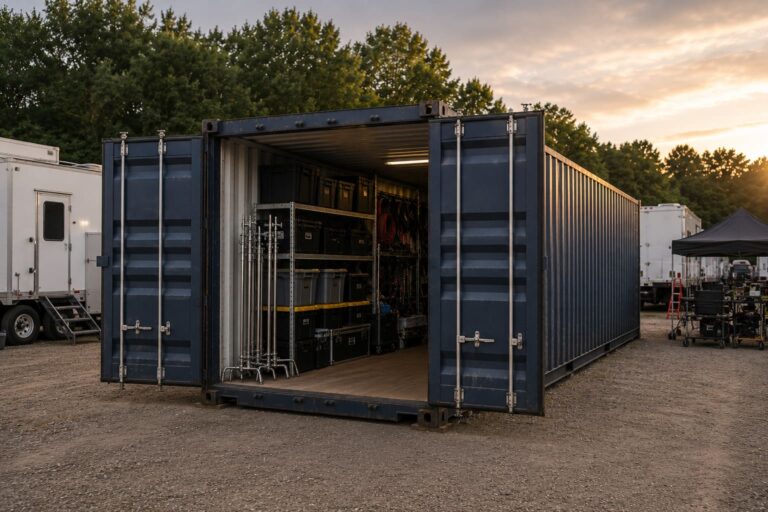
A 40ft container can be divided into zones: tools and hand equipment on one side, power equipment on the other, with consumable supplies organized at the back. This kind of organized layout improves daily efficiency when multiple crew members are accessing the container at the start of a shift.
For operations that use a container primarily as a centralized yard storage unit rather than a mobile job site resource, the 40ft format makes more sense. It holds more, allows better organization, and reduces the need for a second unit as the business grows.
The condition decision usually comes down to where the container will be used and who will see it.
For containers that live at a depot, yard, or back-of-property storage location, a used container in cargo-worthy condition is the practical choice. The cosmetic wear on a used unit has no bearing on its ability to keep equipment dry and secure, and the cost savings are meaningful when a company is equipping multiple job sites or replacing aging storage solutions.
For containers placed at client properties, commercial sites, or locations where appearance reflects on the company, a new one-trip unit arrives in consistent condition with no exterior blemishes. Some landscaping companies use a new container as a selling point when pitching long-term maintenance contracts, presenting it as part of a professional, organized approach to their on-site operations.
Job site placement is different from permanent property placement. Containers on active landscaping job sites need to work around construction traffic, client access, and municipal regulations that may apply to temporary structures on commercial or residential properties.
Position the container so that both doors can open fully without obstruction. Crew members retrieving equipment at the start of the day should be able to do so quickly without moving other items out of the way. Enough clearance in front of the doors to maneuver a ride-on mower or walk-behind equipment in and out smoothly is an often-overlooked requirement.
Job site ground conditions vary significantly. Containers placed on soft soil, freshly graded areas, or sites where ground disturbance is ongoing should be positioned on blocking or timber sleepers to maintain level placement and prevent corner sinking. On paved surfaces such as parking areas, containers can sit directly on the pavement without additional support.
Commercial properties and managed residential developments may have restrictions on what can be placed on-site and where. Before placing a container on a client property, confirm that the placement is permitted under the contract or property management rules. Some commercial property managers are comfortable with containers as part of an active landscaping project; others prefer they be kept off the main property on adjacent staging land.
Consider whether the container will move frequently between sites or be semi-permanent at a single location. Containers that move regularly need to be placed in locations accessible for a delivery truck to return and relocate the unit. Containers placed semi-permanently at a depot or fixed yard location can be positioned more aggressively in tight spots since they won’t need to be extracted until the end of the season or contract.
A stock container works well for most storage purposes, but a few modifications make a noticeable difference in day-to-day usability for landscaping crews.
A personnel door cut into the side panel, separate from the main cargo doors, allows crew members to enter and exit the container without opening the full-width cargo doors each time. This is particularly useful when the container is organized with tools along the walls and the cargo doors are primarily used for moving larger equipment in and out.
Early-morning crew starts and late returns in the fall mean that containers are often accessed in low-light conditions. Battery-powered or solar LED fixtures mounted inside the container improve visibility and reduce the time crews spend searching for equipment. This is a low-cost modification with an immediate practical payoff.
Long-handled tools such as rakes, shovels, edgers, and blowers stored on the floor take up more space and create a disorganized pile that slows access. Wall-mounted racks and hooks keep long tools vertical and organized along the walls, freeing floor space for larger equipment. These can be bolted directly to the container walls without welding.
Many landscaping operations store fuel for small engines in their containers. Fuel storage inside an enclosed steel container requires proper ventilation and must comply with applicable fire code and hazardous materials regulations. Do not store fuel in a sealed, unventilated container. A ventilated container with a compliant fuel storage cabinet is the correct approach if fuel needs to be secured on site.
If your storage needs extend beyond landscaping equipment into broader contractor or trades applications, the article on construction equipment storage using shipping containers covers how similar principles apply across active construction job sites, including security, access, and site configuration considerations that overlap significantly with landscaping operations.
To browse available sizes and current inventory, visit the container shop for a full view of new and used options across all sizes.
Pricing for a landscaping company’s container setup depends on how many units you need, what sizes, the condition you’re targeting, and where delivery is required. Operations that need multiple containers or have sites in different locations may have different pricing considerations than a single-unit purchase.
To get a price built around your specific requirements, use the get a quote form to submit your details and receive a response tailored to your operation rather than a generic price estimate.
Yes, and many do. Shipping containers provide a lockable, weather-resistant storage solution that can be positioned at or near active job sites, eliminating the need for daily equipment retrieval from a central yard. A 20ft container fits on most commercial and residential job sites without consuming significant usable space, and can be relocated when the contract ends or the operation moves. The combination of security, durability, and flexibility makes containers a practical fit for how landscaping companies operate.
Most landscaping operations find a 20ft container to be the most practical size for job site use. It holds a substantial volume of equipment and supplies, fits on most sites, and is easier to deliver and relocate than a 40ft unit. Larger operations that run multiple crews from a single location, or that use a container as a central yard storage unit rather than a mobile site resource, often prefer a 40ft container for the additional capacity and better organizational possibilities it provides.
A shipping container’s standard cam lock hardware provides basic security, but most companies add a heavy-duty padlock or a lock box over the lock rod handles for additional protection. Lock boxes are steel covers that encase the padlock and make it significantly harder to cut with standard tools. For high-risk sites, a secondary locking bar across both doors provides an additional layer of deterrence. The steel construction of the container itself is a substantial barrier against opportunistic theft compared to a standard trailer or tool van.
Yes. Containers are designed to be lifted and transported, which is what they were built for originally. Relocating a container between sites requires booking a tilt-bed or flatbed truck equipped for container transport. The frequency of relocation, the accessibility of each site, and the lead time required to schedule transport should all factor into how you plan container logistics across your operation. For companies that move containers frequently, maintaining a relationship with a reliable delivery operator simplifies the process considerably.
It depends on where the container will be used and what image the company wants to project. For containers placed at a yard, depot, or back-of-property storage location, a used cargo-worthy container is almost always the more cost-effective choice. For containers placed at high-profile client properties, commercial sites, or locations where the container’s appearance reflects on the company’s professionalism, a new one-trip container provides a consistently clean exterior that a used unit cannot match. Some companies maintain a mix of both, using new containers for client-facing sites and used containers for internal storage.
Permit requirements depend on the municipality, the nature of the property, and how long the container will be in place. Many jurisdictions treat a container on a commercial job site as temporary equipment storage and do not require a specific permit, particularly when it is part of an active contracted project. Residential property placements vary more widely. It is always worth confirming with the local municipality and the property owner or manager before positioning a container, especially if it will be on-site for an extended period.
The most effective layouts position frequently used hand tools and consumables at the front of the container near the doors for fast access, with larger equipment such as ride-on mowers or walk-behind units stored at the back. Wall-mounted racks and hooks keep long-handled tools vertical and organized. A personnel door cut into the side panel allows easy daily access without opening the full cargo doors each time. Clear labelling of zones within the container speeds up the morning setup and end-of-day return process, particularly when multiple crew members are accessing the container simultaneously.